Skip to content
TV TESTVECTOR
Menu

Services

QA consulting services for teams that need stronger release evidence

If your team has tests but still hesitates before release, I find the missing checks: backend behavior, stale data, flaky UI automation, untested data paths, noisy CI, and workflows that only look covered.

Best first step

Not sure where to start?

Start with a QA Signal Audit. It separates checks that prove useful behavior from checks that only make the suite look larger.

You leave with the failure modes worth fixing first.

Starting at $1,500

QA Signal Audit

Best for: Teams with tests that still cannot explain which failures would reach production.

Typical timeline: 1-2 weeks

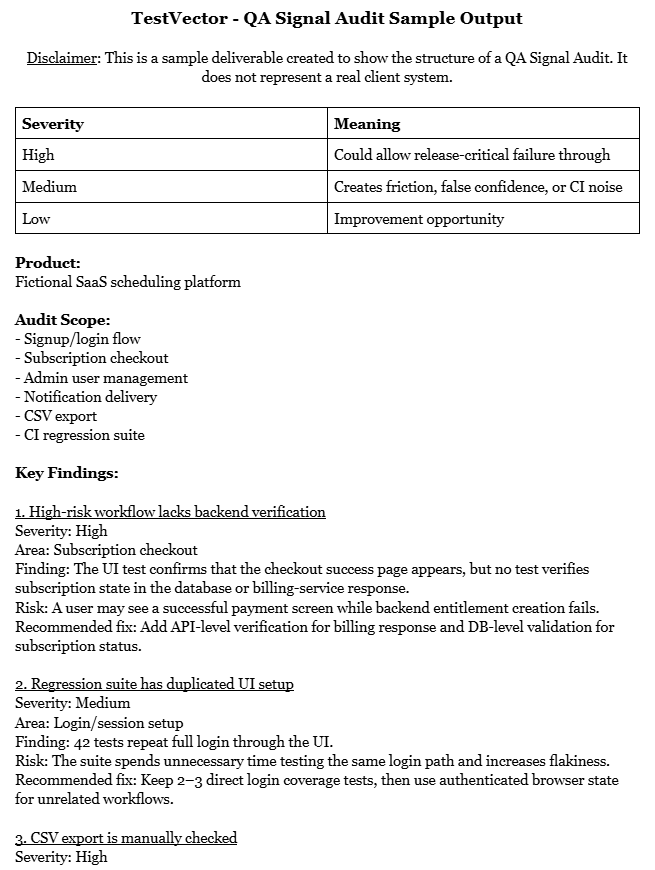
See a sample deliverable with findings, severity ratings, recommended fixes, and a 30-day action plan.

Sample QA Signal Audit output with findings, severity ratings, risks, fixes, and a 30-day action plan

Not sure if you need an audit yet? Start with the QA Signal Checklist.

Download QA Signal Checklist

What I review

  • current test coverage
  • manual regression process
  • UI/API/backend/data coverage
  • CI reliability
  • flaky/noisy tests
  • critical workflows
  • release risk areas

Deliverables

  • QA signal gap report
  • prioritized risk map
  • recommended coverage by layer
  • automation cleanup recommendations
  • short-term and medium-term action plan
Starting at $5,000

Automation Framework Build / Rebuild

Best for: Teams that need automation built around product behavior, not fragile test counts.

Typical timeline: 2-6 weeks depending on scope

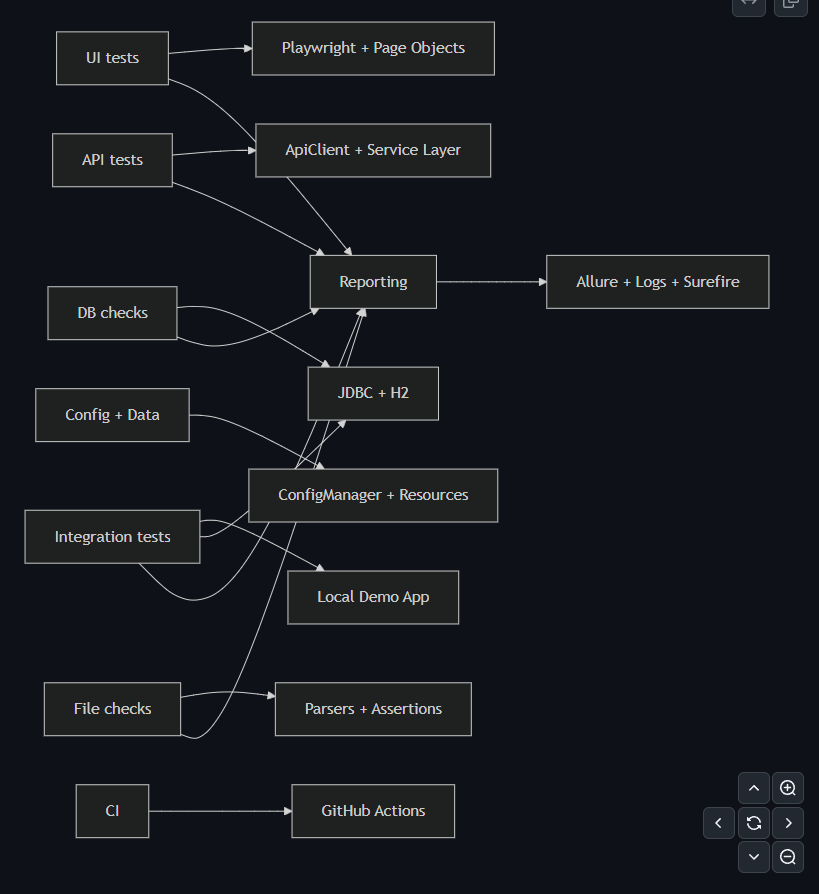
See an example stack with test layers, usage examples, reporting, and CI wiring.

Demo automation framework architecture showing UI, API, data, file, reporting, and CI layers

What I build

  • Playwright-based UI automation
  • API verification
  • database validation
  • file/output validation
  • CI integration
  • reporting
  • practical test structure
  • maintainable test data patterns

Deliverables

  • working automation framework
  • example tests across relevant layers
  • documentation
  • CI-ready execution
  • reporting setup
  • handoff walkthrough

Starting at $2,500

Data and Output Verification

Best for: Products where bad data, stale outputs, generated files, reports, or backend state can create expensive mistakes.

Typical timeline: Scoped based on workflow complexity

What I verify

  • source-to-output consistency
  • database state changes
  • generated TSV/CSV/JSON/XML files
  • reports and exports
  • backend workflow results
  • edge cases and malformed input

Deliverables

  • verification strategy
  • automated checks where appropriate
  • comparison tools/scripts
  • repeatable validation process
  • documented expected behavior

Starting at $2,000/month

Ongoing QA Advisory

Best for: Teams that need senior QA judgment without hiring full-time or working through agency layers.

Typical format: Monthly advisory or scoped consulting

What I help with

  • release risk review
  • QA strategy
  • test planning
  • automation prioritization
  • CI/test suite triage
  • coverage decisions
  • developer/QA workflow alignment

Deliverables

  • recurring QA review
  • prioritized action items
  • test strategy support
  • tactical implementation guidance

Final scope depends on product complexity, number of workflows, current test setup, CI needs, backend/data complexity, and how much implementation support is required.

Positioning

Senior QA judgment matters when the suite cannot explain the release.

QA agency

Optimizes for: process, capacity, staffing

Gap: can add management layers, cost, and generic process

Offshore vendor

Optimizes for: low-cost execution and volume

Gap: can lack product context, architecture context, and release judgment

AI test-generation tool

Optimizes for: fast test creation

Gap: cannot decide which behavior should block a release

TestVector

Optimizes for: senior QA judgment and targeted verification

Gap: best when the team wants diagnosis and implementation instead of cheap test volume

ROI

When this pays for itself

  • A smoke suite that drops from hours to under 20 minutes saves release time every cycle.
  • A flaky suite that stops wasting developer attention makes CI worth reading again.
  • Backend/data checks catch failures UI tests cannot see.
  • Expanded datasets expose supported states that production-like regression never covered.
  • Better test layering reduces expensive E2E bloat.
  • A maintainable framework prevents the dust-collecting suite problem.

Next step

Want a smaller first step?

Download the QA Signal Checklist to inspect stale outputs, flaky setup, missing backend checks, and test suites that take too long to trust.